
Is Your Container Ready?
Get In Contact With Us Today
Is Your Container Ready?
Get In Contact With Us Today
What Is the Best Well Drilling Equipment for Global Buyers?
Choosing the best Well Drilling Equipment requires more than comparing horsepower, prices, or catalogue photos. Global buyers face different geological, regulatory, and operating conditions. A compact rotary rig may perform efficiently in fractured rock, yet struggle in loose alluvial soil. A larger crawler rig may offer deeper drilling, but transport costs can quickly reduce its value.
Demand remains substantial. The WHO and UNICEF Joint Monitoring Programme reported that 2.2 billion people lacked safely managed drinking water in 2022. This gap continues to support investment in boreholes, rural water systems, and groundwater development. The World Bank also identifies groundwater as a critical resource for climate resilience and agricultural security. For energy projects, the International Energy Agency reports continuing growth in geothermal interest, creating additional demand for specialized drilling systems.
The “best” choice is rarely universal.
Industry data also requires careful interpretation. Baker Hughes rig-count reports measure active drilling activity, not total equipment sales or future demand. Commercial market studies may estimate strong growth, but their methods and regional assumptions often differ. Buyers should verify claims through field trials, service records, spare-parts availability, and local technician support.
A practical evaluation should examine drilling depth, formation hardness, torque, air consumption, mud-pump capacity, mobility, fuel use, and maintenance access. Operator experience matters too. A reliable rig with familiar controls may outperform a more advanced machine in remote conditions. This guide compares major equipment types and selection factors, while acknowledging an uncomfortable truth: the cheapest purchase is often the most expensive decision later.
Types of Well Drilling Equipment for Different Applications
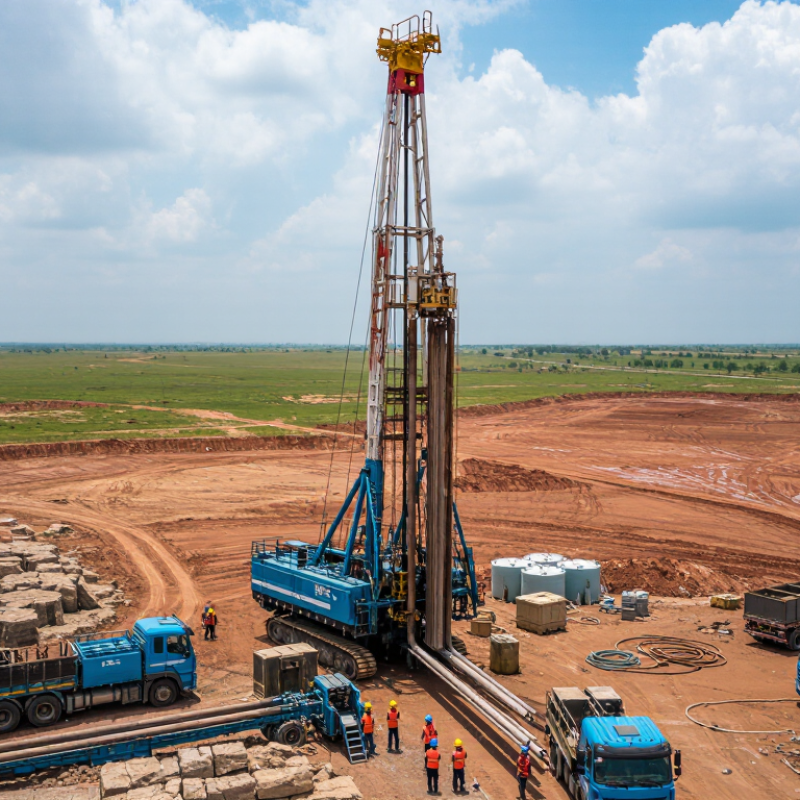
The best well drilling equipment depends on geology, depth, water quality, and site access. Groundwater supplies nearly half of the world’s drinking water, according to UNESCO’s World Water Development Report 2022. That demand requires equipment matched to real field conditions, not catalog assumptions.
Rotary mud rigs suit unconsolidated sand, clay, and gravel because drilling fluid supports unstable borehole walls. Rotary air systems and down-the-hole hammers perform better in hard rock, where compressed air clears cuttings quickly.
Geology decides.
Cable-tool rigs remain useful for shallow formations and careful sampling, although they usually drill more slowly. Auger rigs are practical for shallow monitoring wells and soft soils, especially where transport space is limited.
Sonic rigs can reduce sample disturbance and handle mixed layers, but their higher cost may not suit every project. For geothermal applications, buyers often need stronger torque, deeper reach, and precise circulation control. The International Energy Agency reports that geothermal energy could meet a larger share of global heating demand with suitable resources and investment.
However, equipment selection still requires local testing. A drilling plan based only on regional maps can fail at the first fractured layer. Review pump capacity, mast height, spare parts, operator training, and environmental rules before purchase.
The cheapest rig may become expensive underground.
Sources: UNESCO, World Water Development Report 2022; International Energy Agency, The Future of Geothermal Energy, 2024.
Key Factors for Comparing Drilling Equipment Globally
Global drilling buyers should compare equipment by site conditions, not by appearance or advertised power. Soil layers, rock hardness, groundwater depth, and required bore diameter can change the best choice. A compact rotary rig may suit urban work, while a heavier crawler rig may perform better on fractured ground. Start with a verified site survey.
Transport also matters. Check the machine’s total weight, folded dimensions, lifting points, and fuel requirements. A rig that reaches the site easily reduces delays and handling risks. Ask for clear performance data, including drilling depth, torque, feed force, and expected output in similar formations. Marketing figures can be optimistic.
Maintenance often separates reliable equipment from expensive equipment. Compare engine access, spare-part availability, service training, and hydraulic component quality. Review inspection records, operating manuals, and safety controls before purchasing. Local technicians should understand the system, especially where remote support is limited. Small details matter.
Water and dust are not minor issues. Sealed controls, effective filtration, and corrosion-resistant components can protect performance in harsh environments. Confirm that electrical systems and guarding match the destination’s accepted standards. A practical mistake is choosing maximum capacity without checking operator skill or transport limits. Bigger is not always better. The comparison should include total ownership cost, not only the purchase price. Even experienced buyers can overlook downtime caused by difficult maintenance access. That weakness deserves honest attention.
What Is the Best Well Drilling Equipment for Global Buyers?
The chart compares representative operating depth ranges for widely used well-drilling equipment categories. Truck-mounted rotary rigs generally provide strong mobility and higher depth capacity, while DTH and crawler rigs are often preferred for hard-rock or remote-site applications. Actual performance depends on geology, hole diameter, drilling method, tooling, and local regulations.
Data basis: typical industry operating ranges compiled from public drilling-equipment specifications and field-practice references; values are indicative rather than brand-specific.
How to Match Equipment With Soil, Rock, and Well Depth
Choosing well drilling equipment starts with ground conditions, not a catalog. Soil can change quickly, even across one farm. Loose sand may collapse around the hole, while clay can swell and clog tools. Rotary drilling with casing support often suits unstable formations. Auger systems can work efficiently in shallow, cohesive soil, but they may struggle below groundwater. Field logs, trial pits, and local drillers’ experience provide stronger evidence than assumptions. In my field experience, one soil sample has prevented expensive equipment changes. However, samples can mislead when weathered rock lies beneath soft ground.
Hard rock demands different torque, pressure, and bit design. Air-percussion methods can penetrate competent rock rapidly, especially in deeper boreholes. Rotary mud drilling may provide better wall control in fractured formations. For mixed ground, choose equipment that can change methods without long downtime. Well depth also affects mast height, pump capacity, rod length, and compressor output. A machine rated for 150 meters may perform poorly at that depth in dense rock. Manufacturer ratings require careful, site-specific review. That detail is easy to overlook.
Tips: Confirm geological data before ordering. Ask a qualified drilling engineer to review soil reports, target depth, groundwater levels, and access limits. Check local safety requirements and operator training needs. Keep spare rods, seals, and suitable bits available. Even the right machine can underperform when maintenance planning is weak.
Evaluating Power Systems, Mobility, Safety, and Maintenance
What Is the Best Well Drilling Equipment for Global Buyers?
For global buyers, the best well drilling equipment depends on site conditions, not impressive specifications alone. Power systems deserve careful attention. Diesel engines can support remote work, while electric systems may reduce noise and local emissions. Check fuel access, voltage stability, altitude, and daily operating hours before choosing. Power matters.
Mobility also affects real productivity. A compact rig with strong tires may reach narrow farms and uneven ground more easily. Track-mounted equipment can improve stability on soft soil, but transport costs may rise. Ask whether the unit fits local roads, trailers, and loading tools. I once underestimated transport distance; the drilling plan became slower and more expensive.
Safety should be practical and visible. Look for emergency stops, guarded moving parts, secure drill-rod handling, and clear operator controls. A stable mast reduces unnecessary movement during drilling. Workers also need training, protective equipment, and a simple inspection routine. Keep it visible. Maintenance is equally important. Choose equipment with accessible filters, common replacement parts, readable service instructions, and reliable technical support. Check hydraulic hoses for cracks, clean air filters, and inspect connections every operating day. Record pressure, fuel use, and unusual vibration. These small records can reveal problems early. No machine is perfect. A strong purchase still needs disciplined care.
What Is the Best Well Drilling Equipment for Global Buyers? - Evaluating Power Systems, Mobility, Safety, and Maintenance
| Equipment Type | Typical Drilling Method | Typical Depth Range | Common Hole Diameter | Power System | Mobility | Safety Considerations | Maintenance Profile | Best-Fit Applications |
|---|---|---|---|---|---|---|---|---|
| Truck-Mounted Rotary Rig | Rotary mud, air rotary, or reverse circulation | Approximately 100–600 m, depending on geology and configuration | 150–450 mm | Diesel engine with hydraulic transmission; auxiliary generator may be fitted | Excellent road transport and rapid relocation between sites | Stabilizers, mast-locking system, rotating-part guarding, dust control, and high-pressure-fluid protection are essential | Moderate to high; requires engine, hydraulic, mud-pump, mast, and drilling-fluid inspections | Production water wells, exploration, geotechnical drilling, and larger multi-site projects |
| Crawler-Mounted Rotary Rig | Rotary mud or air rotary | Approximately 80–500 m | 100–400 mm | Diesel-hydraulic system; some models use electric drives with an external generator | Very good off-road mobility, low ground pressure, and strong stability on uneven terrain | Track stability, emergency stop controls, operator exclusion zones, and rollover awareness are important | Moderate; track tension, hydraulic hoses, filters, mast structure, and rotary head need regular checks | Remote water-well construction, rural infrastructure, mining exploration, and difficult access routes |
| Truck- or Trailer-Mounted DTH Rig | Down-the-hole hammer with compressed air | Approximately 100–500 m in competent formations | 115–300 mm | Diesel engine driving a high-capacity air compressor and hydraulic systems | Good transportability; trailer versions generally require a suitable towing vehicle | Compressed-air hose restraints, noise protection, dust suppression, and hammer ejection controls are required | High; compressor oil, air filters, hammer wear parts, drill rods, and air lines require close attention | Hard-rock water wells, quarry work, foundation drilling, and mineral exploration |
| Portable or Skid-Mounted Rig | Light rotary, air rotary, or percussion drilling | Approximately 30–200 m | 75–250 mm | Electric motor, hydraulic power pack, or compact diesel engine | Good for narrow paths and restricted sites; often requires winching or manual positioning | Manual-handling limits, secure anchoring, electrical isolation, and guarded rotating components are critical | Low to moderate; simpler drivetrains reduce service needs, but alignment and anchoring must be checked | Domestic wells, environmental sampling, shallow geotechnical work, and urban sites |
| Auger Drilling Rig | Continuous-flight or hollow-stem auger | Typically 5–60 m, with greater depths possible in favorable soils | 100–400 mm | Mechanical or hydraulic drive, commonly powered by diesel or electric motors | High mobility on prepared ground; compact versions suit small sites | Flight guarding, entanglement prevention, spoil management, and stable setup are essential | Low to moderate; inspect auger flights, drive chains, bearings, hydraulic lines, and teeth | Soil investigation, shallow wells, sampling, drainage, and foundation surveys |
| Sonic Drilling Rig | High-frequency resonant vibration with casing advancement | Approximately 30–300 m, depending on formation and tooling | 100–300 mm | High-power diesel-hydraulic system with a dedicated resonant oscillator | Usually truck- or crawler-mounted; heavier and more complex to transport | Noise and vibration exposure, secure casing handling, isolation zones, and structural inspections are required | High; oscillator bearings, hydraulic circuits, tooling, casing, and vibration mounts need specialist service | High-quality core or soil sampling, contaminated-site investigation, and difficult unconsolidated formations |
| Electric-Hydraulic Rig | Rotary, auger, or DTH drilling, depending on attachments | Approximately 50–400 m | 100–350 mm | Electric motor powered by grid supply, generator, or battery-supported system | Best for fixed or semi-fixed sites with dependable electrical infrastructure | Lockout/tagout, grounding, residual-current protection, cable management, and hydraulic-pressure controls are necessary | Moderate; fewer engine components, but electrical systems, cooling, hydraulics, and software controls require qualified technicians | Urban projects, enclosed facilities, low-emission sites, and locations with reliable grid power |
Selecting Reliable Suppliers and Managing International Purchases
Global buyers should judge a drilling rig beyond engine power. Supplier reliability affects uptime, safety, and total delivered cost. The UN World Water Development Report 2022 says groundwater provides nearly half of global drinking water. That demand makes dependable equipment critical. Ask suppliers for factory test records, production photos, serial-number traceability, and references from comparable geology. A video call is useful. It is not proof. Request a witnessed factory acceptance test before final payment.
Technical fit must be documented. Compare torque, rotary speed, drilling depth, compressor output, mast load, and available tooling. Match these figures with your formation, casing sizes, and water conditions. Require drawings, manuals, maintenance intervals, and a complete spare-parts list. Independent inspection can verify weld quality, hydraulic leaks, and electrical protection. Certificates alone can mislead. A stamped document does not replace a pressure test.
International purchasing needs a landed-cost worksheet. Include freight, insurance, duties, port charges, inland transport, commissioning, and training. The World Bank’s 2023 Logistics Performance Index assessed 139 economies and reported that about 60% of shipments arrive within expected time. Build schedule margin into contracts. Use clear Incoterms, milestone payments, inspection rights, warranty response times, and remedies for missing parts. Check export documents before loading. Local service capacity often matters more than a slightly lower quotation. Buyers sometimes compromise too quickly. I would rather delay a purchase than discover a failed pump beside an unserviceable rig.


