Is Your Container Ready?
Get In Contact With Us Today
Is Your Container Ready?
Get In Contact With Us Today
China Top Steel Container Manufacturers for Global Buyers
Choosing reliable China top steel container manufacturers requires more than comparing factory prices. Global buyers must examine production experience, material quality, design capability, and communication practices. A dependable supplier should explain steel grades, welding methods, surface treatments, and load requirements clearly. Factory photographs help, but verified records matter more. An on-site audit, sample inspection, or independent quality check can reveal details that brochures often miss.
This guide introduces experienced Chinese manufacturers serving international buyers across storage, transport, construction, and industrial applications. Each supplier should be assessed against practical points, including dimensional accuracy, corrosion protection, customization, packaging, and delivery control. Ask for drawings before production. Request certificates when relevant. Confirm tolerances in writing. Small details matter. A poorly aligned door can delay an entire project.
Price alone is not a reliable purchasing strategy. A low quotation may exclude testing, protective coating, export packaging, or replacement support. That assumption deserves testing. Buyers should also review factory capacity, lead times, after-sales service, and experience with destination requirements. No supplier is perfect, and even strong manufacturers can face material delays or communication gaps. Honest evaluation helps reduce those risks.
The right steel container manufacturer combines technical competence with consistent documentation and responsive service. This article offers a practical framework for comparing leading Chinese suppliers. It also recognizes an important limitation: supplier information changes over time. Buyers should verify current certifications, production conditions, and commercial terms before placing an order. Careful research creates stronger partnerships and more predictable results.
China’s Steel Container Industry: Export Scale, Clusters, and Capacity
China Top Steel Container Manufacturers for Global Buyers
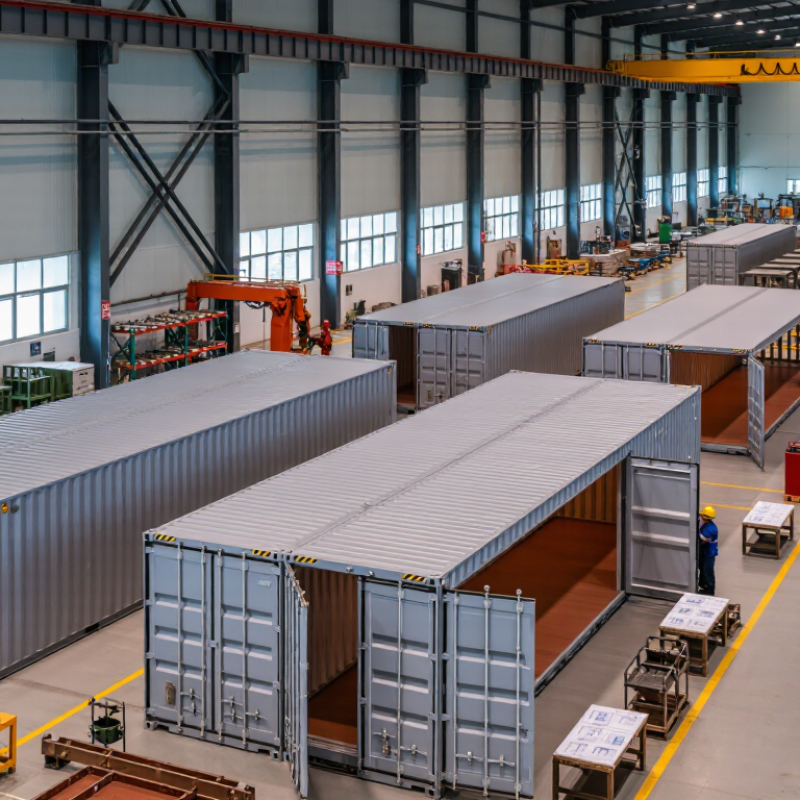
China’s steel container industry has grown through strong manufacturing capacity, port access, and mature supply networks. Major production clusters sit near coastal shipping hubs, where steel processors, welding workshops, coating suppliers, and logistics providers operate closely together. This structure helps manufacturers manage large export orders and shorten delivery planning.
Production capacity varies widely. Some factories focus on standard dry containers, while others handle refrigerated units, open-top designs, or customized cargo solutions. Experienced buyers should examine monthly output, welding quality, coating systems, inspection records, and loading procedures. Export scale matters, but it does not guarantee consistent performance. A factory may report impressive capacity while depending heavily on subcontractors. That difference deserves careful checking.
Tips: Request recent production photos, material certificates, and third-party inspection options. Compare sample quality before discussing annual volume. Ask how the factory controls rust protection during storage and ocean transport. Confirm port distance, packing methods, replacement policies, and communication speed. Small details can reveal operational discipline.
China’s industry is efficient, yet not flawless. Steel prices, labor availability, and shipping schedules can change quickly. Even a capable supplier may face delays during peak seasons. Buyers should keep realistic lead times and document every technical requirement. A clear specification sheet reduces misunderstandings across languages, time zones, and production teams.
ISO 668 Standards: Comparing 20-Foot TEU and 40-Foot Steel Containers
For global buyers, ISO 668 offers a practical framework for comparing steel containers.
A 20-foot container equals one TEU. A 40-foot container equals two TEU. Both usually measure 2.438 meters wide and 2.591 meters high externally.
The 20-foot model is about 6.058 meters long, while the 40-foot model reaches approximately 12.192 meters. These dimensions support consistent handling across ships, rail networks, and terminals.
The 20-foot unit suits dense cargo, machinery, and shorter loading plans. Its compact floor area can reduce unused space when cargo is heavy. The 40-foot unit provides more volume for cartons, furniture, or packaged equipment.
However, length does not automatically mean better value. Cargo weight limits, axle rules, and internal dimensions still require careful checking. ISO 668 defines key external dimensions and compatibility requirements, but it does not replace condition inspections or local transport rules.
In real purchasing work, published measurements can vary slightly because of manufacturing tolerances and repairs. That detail is easy to overlook.
Tips: Confirm internal length, door opening, tare weight, and payload separately. Ask for recent inspection records and clear photos of the floor, roof, doors, and corner castings. Choose a 20-foot container for heavier concentrated loads. Select a 40-foot unit when volume matters more than weight. High-cube versions add height, but they should not be treated as identical to standard-height containers. A small calculation mistake can create expensive empty space.
ISO 1496-1 Testing: Payload, Tare Weight, and Structural Performance
China Top Steel Container Manufacturers for Global Buyers
ISO 1496-1 testing gives global buyers a practical way to judge container safety. It examines payload, tare weight, and structural performance under controlled conditions. Payload is not simply the advertised capacity. It is the maximum gross mass minus the container’s verified tare weight. A 30,480-kilogram gross limit means less usable cargo when fittings, flooring, or repairs increase tare weight.
A reliable factory should measure tare weight on calibrated scales and record the result for each production batch. Inspectors also review floor strength, corner fittings, lifting points, and roof behavior. Stacking tests apply vertical loads through the corner posts. Lifting tests check whether the loaded container remains stable without harmful deformation. Small errors matter. A bent corner casting may look minor, but it can affect crane handling and vessel securing.
In practice, buyers should request test reports, material records, and dimensional inspection data from an independent or properly qualified laboratory. Steel grade, weld quality, coating thickness, and door alignment deserve close attention. Photos help, but they cannot replace physical inspection. I have found that neat documentation sometimes hides inconsistent measurements. That possibility deserves honest checking. A stronger purchasing process compares test results with the actual unit, not only with a catalogue specification. Weather exposure, repeated handling, and uneven loading may reveal weaknesses that a single factory test misses.
CSC Safety Certification: Auditing Chinese Manufacturers for Global Trade
For global buyers, a steel container is not ready for shipment because it looks strong. Its CSC safety certification shows that the unit meets international requirements for transport. A serious audit begins with documents, not polished factory tours. Review the manufacturer’s approval scope, inspection history, welding procedures, and corrective-action records. Check whether certificates match container types, dimensions, and production locations. Small mismatches matter. They can delay loading or weaken buyer confidence.
During a factory visit, auditors should trace one container from raw steel to its final plate. They examine steel grades, weld penetration, corner fittings, door locks, floor strength, and coating thickness. Measurements need calibrated tools and dated records. Visual checks alone are not enough. Load tests and periodic inspections should follow documented procedures. Serial numbers must connect the container, test results, and certificate. In my experience, missing traceability often reveals a larger control problem. Easy to overlook.
Buyers should also interview quality staff and compare production samples with approved drawings. A factory may pass one inspection yet struggle during peak orders. Capacity planning, subcontractor control, and employee training deserve equal attention. Ask how defects are isolated and how repairs are documented. Do not treat CSC approval as a permanent guarantee. Certificates have validity conditions, and design or process changes may require reassessment. One practical weakness remains common: audit reports can describe compliance without showing enough evidence. Request photos, test data, calibration records, and independent verification when risk is high. It costs time.
ISO Steel Container Dimensions Relevant to CSC Safety Audits
The chart compares nominal external dimensions for widely used ISO steel freight containers. CSC certification is assessed on each individual container and requires verification of structural safety, maximum gross mass, stacking strength, racking strength, identification markings, and valid inspection status. Dimensions alone do not constitute CSC approval.
Supplier Comparison: Steel Grades, Lead Times, Pricing, and After-Sales Support
Choosing a steel container supplier requires more than comparing quoted prices. Steel grade affects strength, corrosion resistance, and service life. Carbon steel suits many dry storage applications, while galvanized or stainless steel may perform better in humid or coastal environments. Ask for mill certificates, coating thickness, weld inspection records, and load-test evidence. A polished brochure is not proof.
Lead times often range from 15 to 45 days, depending on customization, production capacity, and port schedules. Confirm the sample approval date, fabrication window, inspection point, and shipping responsibility in writing. Pricing should include steel grade, wall thickness, fittings, packaging, inland transport, and replacement parts. A low quote can still be wrong for your site. In procurement reviews, overlooked drainage details have caused avoidable maintenance costs.
Tips: Compare landed cost, not unit price. Request a production photo before shipment. Check how quickly technical questions receive clear answers. After-sales support should cover spare parts, installation guidance, warranty limits, and documented claim procedures. Response time matters when a door seal fails during a busy season. Suppliers may promise everything, yet their support process can remain vague. That deserves closer questioning.
China Top Steel Container Manufacturers for Global Buyers - Supplier Comparison: Steel Grades, Lead Times, Pricing, and After-Sales Support
| Supplier Profile | Typical Production Region | Common Container Types | Typical Steel Grades and Materials | Manufacturing and Quality Controls | Indicative Lead Time | Indicative FOB Price Range | Customization Capability | Export Documentation | After-Sales Support | Best Fit for Global Buyers |
|---|---|---|---|---|---|---|---|---|---|---|
| Large-scale export manufacturer | Coastal manufacturing cluster in East China | 20 ft and 40 ft dry containers; high-cube units; refrigerated-container shells |
Weathering steel equivalent to CORTEN-type specifications; structural steel such as Q235B and Q355B; galvanized components for selected parts |
Automated welding lines, dimensional inspection, coating-thickness checks, water-tightness testing, and production traceability | 25–45 days after design confirmation and deposit | Approximately US$2,200–4,000 for a standard 20 ft dry container | High; doors, vents, flooring, paint system, locking gear, and internal fittings | Commercial invoice, packing list, certificate of origin, bill of lading, inspection report, and relevant CSC documentation when applicable | Spare-parts supply, remote technical support, warranty handling, replacement-component guidance, and claim documentation | Large-volume importers, leasing fleets, logistics operators, and distributors |
| Mid-sized OEM container factory | Established industrial zones in Jiangsu or Zhejiang | Dry containers, open-top containers, side-opening units, and modified storage containers |
Q235B for general structural components; Q355B for higher-strength members; weathering steel for exposed panels and frames when specified |
Manual and semi-automated welding, weld visual inspection, coating inspection, door-operation testing, and random dimensional checks | 30–55 days after approval of drawings and specifications | Approximately US$2,400–4,500 for a standard 20 ft dry container | Very high; suitable for non-standard dimensions, shelving, electrical systems, and access doors | Standard export documents plus material certificates, factory inspection records, and customized packing instructions | Direct engineering communication, installation guidance, spare-parts quotations, and limited warranty coordination | Buyers requiring tailored units or medium-sized production batches |
| High-volume standardized manufacturer | Major container-production base in South China | Standard 20 ft, 40 ft, and 40 ft high-cube dry containers |
Weathering steel panels and frames; Q235/Q345 or equivalent structural grades according to the approved design; marine plywood or bamboo flooring options |
Standardized jigs, batch welding procedures, line inspection, paint-film measurement, door-seal checks, and water-spray testing | 20–40 days for standard configurations; longer for peak-season orders | Approximately US$2,100–3,800 for a standard 20 ft dry container | Moderate; strongest for standard specifications and approved accessory options | Commercial invoice, packing list, certificate of origin, shipping documents, and inspection certificate on request | Standard warranty policy, production-issue investigation, replacement hardware, and online service support | Fleet replenishment, resale inventory, and buyers prioritizing unit cost |
| Specialized modified-container fabricator | Industrial fabrication centers in Central or East China | Site offices, workshops, kiosks, mobile laboratories, retail units, and storage conversions |
Q235B or Q355B structural steel; galvanized steel for corrosion-sensitive parts; insulated sandwich panels and stainless-steel options where required |
Approved fabrication drawings, structural-load review, insulation inspection, electrical testing, finish inspection, and functional acceptance testing | 45–90 days depending on engineering complexity and equipment content | Approximately US$5,000–25,000+ depending on conversion scope | Excellent; layouts, insulation, windows, HVAC, electrical systems, plumbing, and branding-free finishes | Export invoice, packing list, electrical test records, equipment manuals, material certificates, and project-specific documents | Drawing revisions, commissioning instructions, remote troubleshooting, spare-parts support, and project warranty administration | Construction projects, energy sites, emergency facilities, and modular buildings |
| Quality-focused premium fabricator | Export-oriented factories near major Chinese ports | Dry containers, high-cube units, offshore storage units, and corrosion-resistant cargo boxes |
Certified weathering steel or equivalent; higher-strength structural steel such as Q355B; galvanized or stainless components for demanding environments |
Material-batch traceability, controlled welding procedures, enhanced coating systems, non-destructive testing when specified, and third-party inspection readiness | 40–75 days depending on inspection requirements and specification level | Approximately US$3,000–6,500 for a standard or reinforced 20 ft unit | High; reinforced floors, special lifting points, anti-corrosion systems, and project specifications | Full export documentation, steel mill certificates, coating records, inspection reports, and third-party certificates when contracted | Structured warranty process, documented corrective action, technical files, spare-parts planning, and long-term service coordination | Offshore, mining, chemical, coastal, and high-utilization applications |
| Small-batch and rapid-response supplier | General fabrication parks with access to container ports | Storage containers, short-run dry units, customized cargo boxes, and replacement panels |
Q235B for standard fabrication; Q355B or weathering steel when specified and available; plywood, steel, or composite flooring options |
Incoming material checks, weld inspection, basic dimensional verification, paint inspection, and final visual review | 15–35 days for simple standard units; 35–60 days for customized orders | Approximately US$2,500–5,000 for a standard 20 ft unit | High for small orders; subject to available tooling and engineering capacity | Core export documents, packing list, invoice, certificate of origin, and inspection records when requested | Fast communication, replacement hardware, troubleshooting assistance, and case-by-case warranty support | Small importers, replacement orders, pilot projects, and urgent requirements |
Related Posts
-
Best Freight Container Options for Global Buyers Today?
-
What Are the Benefits of Using ISO Containers for Global Shipping?
-
How to Send a Shipping Container Overseas?
-
What are the Benefits of Using a Delivery Container?
-
What is a Delivery Container and How Does It Work?
-
Top 10 Sea Container Suppliers in China for Global Buyers?